



















When a novel is turned into a film, fans of the novel are often disappointed. In order to make something as long as a novel work in the shorter time frame of a movie audiences are used to, large swathes of the book are often left out or egregiously changed. When Andy Weir’s debut novel, “The Martian,” was adapted to the big screen in 2015, it received acclaim for being a great film that also avoided these pitfalls.
“Project Hail Mary” is just as a masterful an adaptation from page to screen, if not more so.
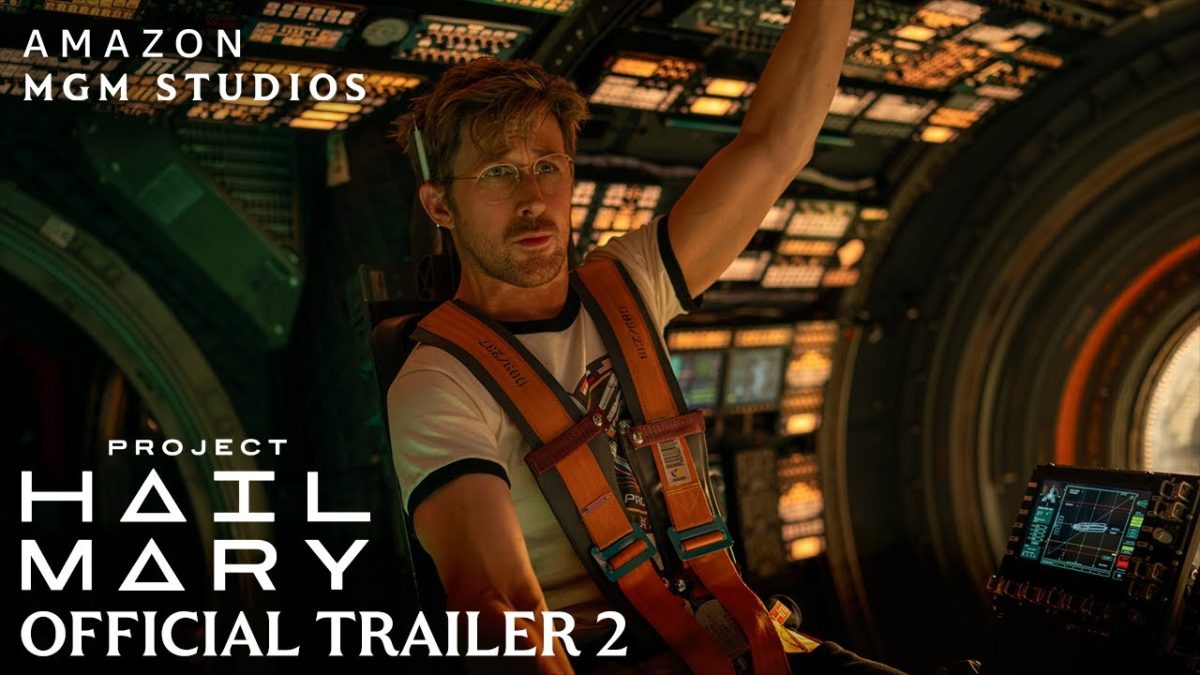
The film starts with Ryland Grace (played by Ryan Gosling) awakening from a coma inside a massive plastic bag. After the bag is unzipped, a robotic hand reaches over him and unceremoniously removes a feeding tube, causing Grace to retch and flail, all while a computerized voice attempts to ascertain the state of Grace’s mental faculties.
Over the next few minutes, Grace is able to stumble away from the robotic arms and learn three important discoveries to set the scene for the rest of the movie: first, that he is on a spaceship; second, that he is the only person still alive; and third, that he has amnesia from his coma, unable to remember even his own name.
Fans of the novel will recognize this opening sequence: It is largely the same as the novel, but much more abbreviated. Changes such as this are what makes the adaptation work done by screenwriter Drew Goddard truly impressive. It marks one of the few departures from the novel, and it’s done purely for the sake of an audience of moviegoers instead of an audience of readers.
This extends to nearly every departure from the novel, from the text-to-speech system for the character of Rocky (voiced by James Ortiz) to a scene late in the movie that was entirely an invention of the film but provides the audience with gorgeous eye candy and helps build out Rocky’s character.
As the film progresses, Grace’s adventures aboard the spaceship Hail Mary are interspersed with flashbacks to his time on Earth leading up to the mission launch. These flashbacks represent Grace’s slowly-returning memory, as he realizes who he is and why he’s aboard the Hail Mary. Conveniently, these also serve to build the film’s world for the audience without needing a lengthy, dry introduction to everything.
The juxtaposition of Grace’s character, a middle-school science teacher thrust into extraordinary circumstances, and Rocky, a genius engineer, makes for an incredible storytelling comparison between the concepts of specialists and jacks-of-all-trades.
While Rocky can build just about anything and nearly-instantaneously solve any problem of physics, there’s a great many more basic scientific concepts he simply doesn’t comprehend that Grace knows intimately from having to answer questions for students. Thus, even though it is often played for humor that Grace is significantly less intelligent than Rocky, the entirety of the story revolves around the fact that both of them are only able to succeed thanks to teamwork.
The performances by Gosling and Ortiz, as well as Sandra Huller (who plays Eva Stratt, head of the titular Project Hail Mary), do an incredible job of lifting the characters off the pages. Gosling not only does a phenomenal job expressing the myriad emotions Grace faces, but also adds entirely new idiosyncratic behaviors that help make Grace seem more like a real person than a character.
Ortiz gives a vibrancy to Rocky that stands shoulder-to-shoulder with Gosling’s performance and also gives Rocky incredible comedic timing to grant levity in dramatic scenes.
“Project Hail Mary” also shows a particular mastery of practical effects. Every scene is shot in an actual set, not in front of a greenscreen with the set built around them in post-production. In fact, director Christopher Miller claimed to The Hollywood Reporter that no greenscreen was used anywhere in the film.
Visual effects artists still got plenty to do, however, between animations for Rocky and backdrops of the planet Adrian featured prominently in the latter half of the film. Adrian, in particular, is a stunning visual, with vivid greens, reds, and oranges that get to be used otherwise rarely in the depths of space, all despite a relatively lacking visual description from the novel (though a very thorough scientific description of the planet’s atmosphere).
That, however, is one aspect of the film some fans may find disappointing. While the novel goes in-depth into the science of everything that happens, often discussing specific chemical compositions, physics calculations and functions of life, the film frequently glosses over them. The closest the film comes to getting down and dirty with the hard science is short shots of Grace scribbling on a whiteboard, with the math and results visible afterward. This occasionally gets used for Easter eggs as well, with minor characters named on a whiteboard when Grace is jotting down things he can remember before they get revealed in a flashback later on.
The film doesn’t shy away from the deep emotion and existential dread of the original story, though. It pulls no punches in depicting Grace’s struggles with the idea that his failure means the extinction of humanity as a whole, with reminders of just how many people will die and how painful it will be for all of them coming from the cold, businesslike Stratt. This leads to him facing death, and oftentimes nearly meeting it, frequently throughout the film – only to learn late in the film that he wasn’t the man he thought he was.
That isn’t to say the film is without joy, of course. Grace and Rocky bond over their shared mission, despite their differences, and ultimately come to love each other like family. Scenes of each making sacrifices to help save the other led to audible open sobs in the theater, as both characters take a turn nearly dying to save their newfound friend. The two also form bonds through inside jokes and even occasional physical comedy.
The soundtrack for the film includes such heavy hitters as Harry Styles and The Beatles, and the overall sound design of the film is top-notch. Not only are the various sound effects punchy and effective, but the design team also make heavy use of volume to convey Grace’s mental state. During scenes where he is in shock or barely hanging on to consciousness, the audio fades into the background into an eerie silence befitting of outer space, and of the trauma Grace faces.
Overall, on top of being an incredible adaptation of one of the best modern science fiction stories out there, “Project Hail Mary” stands tall as simply a phenomenal film. The respect shown to the source material makes it clear this was a labor of love by every team involved in it, and that love has borne a beautiful story of teamwork, of transformation, and of the power of determination.
When the most disappointing thing in the film is a minor change in the last 10 seconds, fans of the novel will truly understand why every review can be summed up in three words: “Amaze amaze amaze!”