








Last summer, an active Brookdale club quietly dissolved. The Dreamers+ Club’s decision not to continue is a direct result of aggressive immigration enforcement tactics across the country.
In 2015, a Brookdale Honors student and DACA recipient in the process of completing his honors project asked a number of questions that led to the club’s founding.
“He presented an awareness that at Brookdale we had no information, no language for a student in his situation wondering if he can go to college,” recounted Dr. Ashley Zamponga-Krug, the former adviser of Dreamers+ and the current advisor of the Society of Latinos, or S.O.L.
“His project resulted in the creation of a grassroots committee of people here at Brookdale – some administrators, faculty from all across the college – to start addressing how we can clarify information for immigrant students.”
That organization prioritized creating information on resources available to immigrant and DACA students and would eventually become part of UndocuAlly at Brookdale Community College.
“At the same time that that was bubbling in 2015, there was also a group of students who wanted to start a club and have a peer component to this,” Zampogna-Krug said. “They started the Dreamers+ club. I remember when they were thinking of the name, dreamers was a really popular term to describe DACA recipients at the time, but [also] a lot of immigrant youth.”
Zampogna-Krug became the adviser for Dreamers+, a group whose main focus was student organization as a means of support for, advocacy for, and education on the immigrant community.
“They’ve held marches on campus, they’ve had ‘know your rights’ workshops, they’ve held DACA renewal clinics. They’ve had financial aid clinics,” Zampogna-Krug said.
All of this would come to an end, though, around the time the second Trump administration began rolling out more aggressive and more severe ICE tactics.
“In 2024, it was a very different kind of vibe. It had gotten to the point where I had maybe two or three students who were still active. In conversation with my students left in Dreamers+, we decided maybe it’s best for now that they [stop].”
Due to a growing concern for safety, a fear of consequence for any kind of public attention, and a lack of membership, the Dreamers+ club ceased operations mid 2025. The club’s last ‘Instagram’ post dates back to June 18, 2025.
In its wake, however, the Dreamers+ club left behind a vacuum, a space for Latino students and supporters to discuss issues that plague their community. The desire for such a space would be answered by the Society of Latinos, SOL.
“In the college, we never really had a Latino-led or Latino-focused organization. I know Dreamers+ was largely Latino, but they focused more on dreamers–which is why we collaborated so much with them,” said Jocelyn Fajardo, the current president of SOL and one of its founding members.
“Unfortunately, some [Dreamers+ members] were uncomfortable to [renew] because of what was going on. At that same time S.O.L was being founded,” Fajardo said.
SOL’s priorities are different from Dreamers+, with a greater emphasis on advocacy and definitive action, Fajardo said.
“We focus more on advocacy but also representation too, appreciation of culture, but also protecting it, too,” she said.
The appreciation occurs at SOL’s biweekly college hour meetings at MAN 108. Their last one, held on Mar. 10, shined a spotlight on the contributions of Latinos to art society. They mentioned artists like Fernando Botero, Carmen Herrera, and José Clemente Orozco. They also encouraged students to express themselves through art by posing the question, ‘What does advocacy mean to you?’
On Feb. 28, SOL members worked alongside other student groups and the American Friends Service Committee to organize a protest against ICE’s actions and push for immigrant justice at Red Bank train station.
Despite SOL and others’ massive success at organizing and protesting the actions of ICE, Latino students continue to face adversity and fear for their safety.
“I know a lot of members that would have gone to Dreamers+ come here now, but some of them are not comfortable being associated with anything that could ‘make them a target,’ essentially. What I’ve heard too, across the college is that overall, Latino attendance has gone down a lot this year. Either they switch over from in-person to online, or they straight up drop out. They’re just not showing up,” Fajardo said.
The struggle for immigrant justice and safety within and without Brookdale is ongoing, but it is the actions of SOL and groups like it that are making those little steps toward a greater goal.
“For us, protesting is a way of making students of the college feel heard. Imagine going to a protest and seeing 50 Brooddale students, you’d think, ‘Oh, there’s obviously an issue that they want addressed, not even just at Brookdale but through the county.’ That’s what protesting means to us: standing up for ourselves but also for those who can’t.”
With concerns and fears ever growing, SOL continues to focus on what impact they are able to make. They continue to organize themselves at protests and share information to members and all over Brookdale campus. While Dreamers+ may be gone, there are still those willing and excited to do the work to help and encourage those around them.
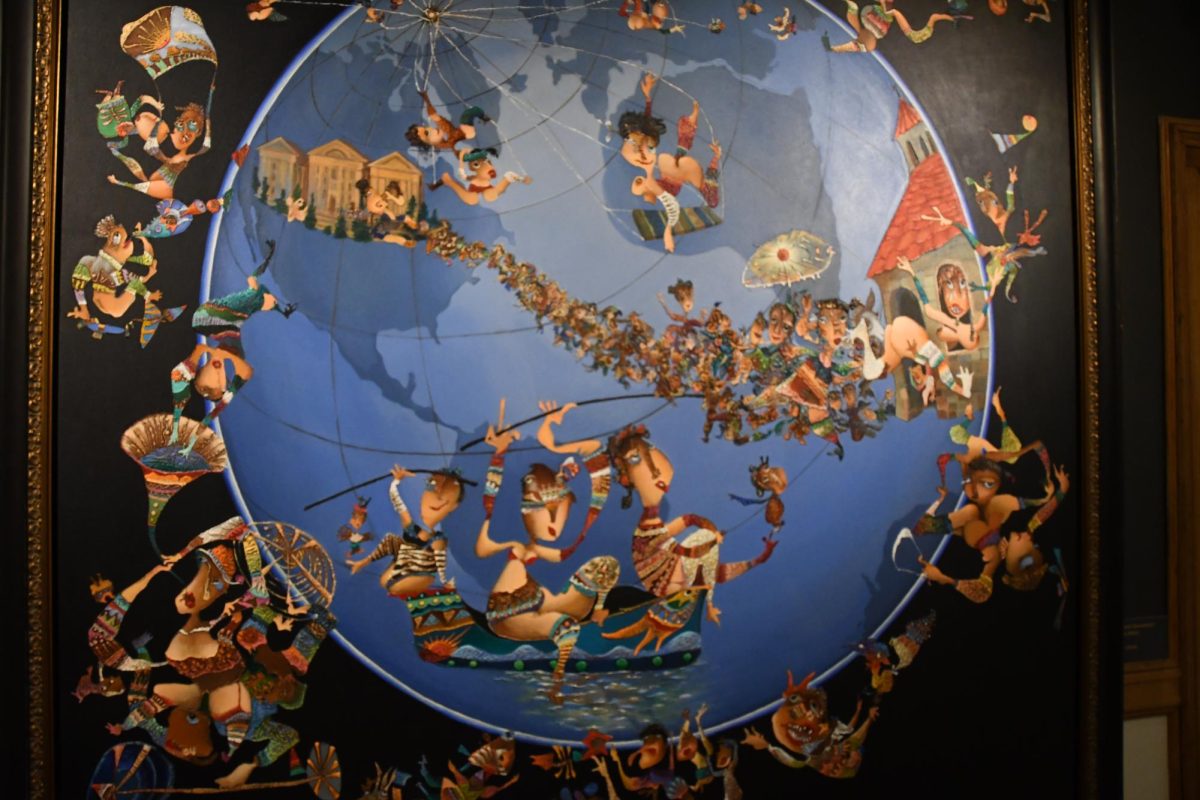
At a recent meeting, SOL members painted what ‘advocacy’ means to them. During this process, students ate snacks procured by leadership at a Brookdale bake sale that was occurring simultaneously, and they shared jokes with one another.
There was a near unanimous consensus to play “Bad Bunny,” while they worked, and students produced all kinds of imagery that was meaningful and deeply personal to each of them. One canvas depicted an eye, with an iris painted to resemble the earth, perhaps representing advocacy as a means of presenting a message to the world.
At the end, that is what the Society of Latinos stands for, building a community and protecting it at all costs.