














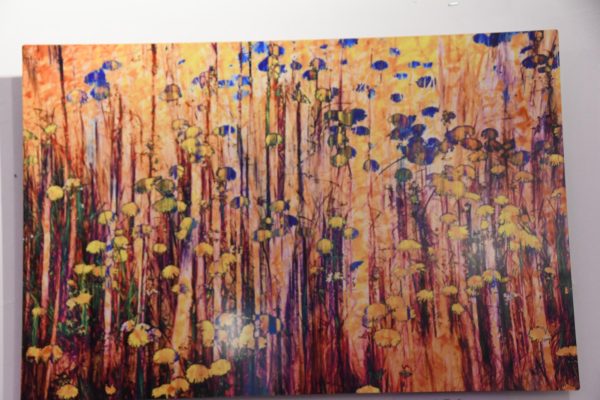
 The Exhibition Memoir: A tribute to Arthur Goldberg was curated by Yelena Kimelblat, a self-taught Ukrainian artist with only a recent introduction to curatorial work. With a background in bold, expressionist paintings, Kimelblat’s introduction to curatorial work happened “naturally.”
As an artist herself who had been exhibiting her work for many years, Kimelblat knows that “artists need space,” which is what led Kimelblat to keep The Museum of Russian Art (MORA) in Jersey City functioning as a space for artists to flourish.
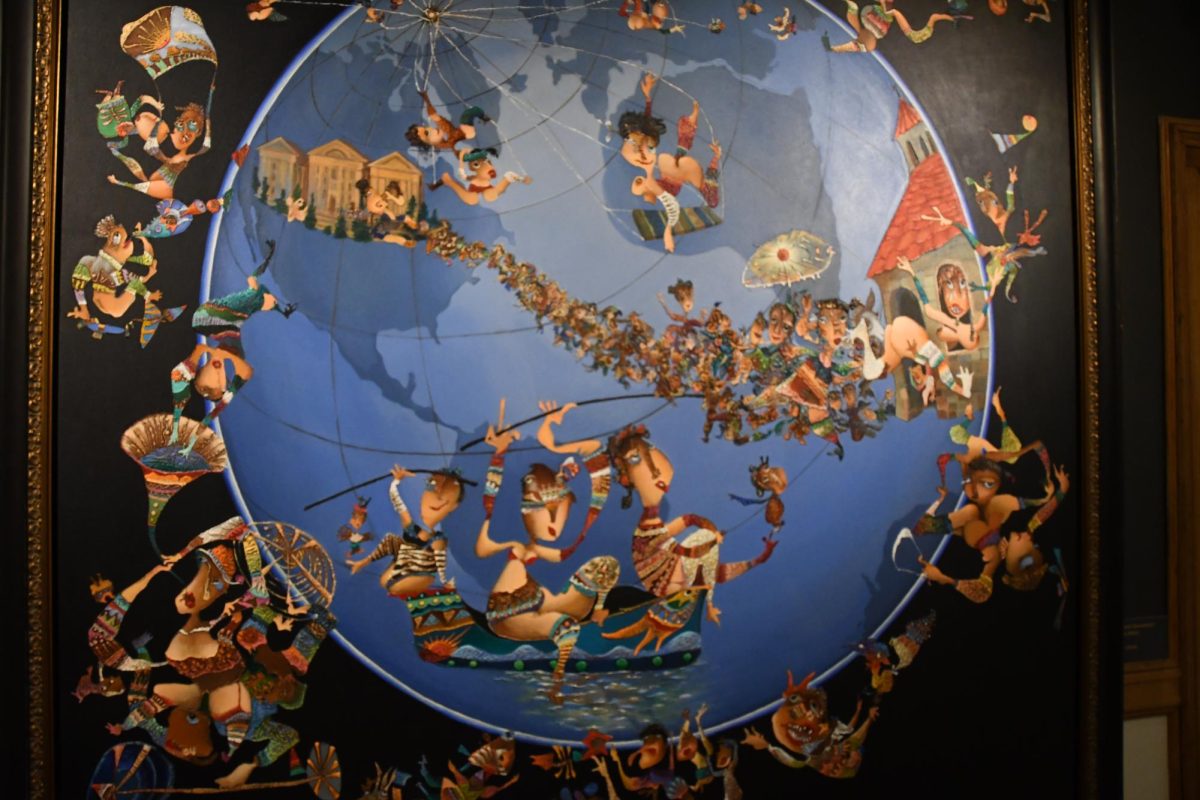
As for this specific exhibition, Kimelblat hopes to convey the message of the main artist, Gabriel “Gabo” Manoukian, whose solo show is titled “A Joyful World,” which Kimelblat argues that “nowadays, that is what what we need.”
“A Joyful World” is a surreal view of happiness, with bold and textured patterns and colors meant to show how “the best way to see happiness is to think like a child.” His Armenian background is heavily referenced in most of his work, but that influence is not intended to provide additional meaning.
George Dagliyan, at the exhibit on behalf of Gabo, made several references to how viewing the art was meant to be a journey of discovery. The more the viewers look at these paintings, the more they realize “there is a lot to discover in each one of his paintings.”
Gabo’s works range in size and frame, although many parallels exist within the subject matter. The way that figures are depicted remain largely consistent. The figures are often represented as structured patchwork – while the patterns follow a specific geometric pattern and rhythm, the form remains rather fluid and organic. This is often reflected in the subject matter of his works – heavily influenced by the idea of folklore and “fairytale.”
Dagliyan explains how Gabo’s supernatural themes are represented across his paintings, where “characters like animals could be kings” and “humans serve animals,” all of which is ultimately meant to portray a “happy world.”
Gabo’s process in making these pieces reflect a level of precision that is not as noticeable at first glance. According to Dagliyan, Gabo is “so meticulous in what he does, he wants to move things around halfway through. Because he uses a gypsum like material,” making the texture of his pieces stand out. “He can’t just erase it and start all over again. So, he’ll start a new canvas for it, regardless of how far in depth he was with that particular painting…He’s a perfectionist.”
Although he primarily uses acrylic on canvas, Gabo’s careful process in creating these works is reflected through detailed, alternating patterns that can be seen throughout all his work. This manner of construction creates paintings that are bold and generous with colors, yet administered with precision and warranting these works a totally unique style.
In Dagliyan’s words, Gabo’s work doesn’t align with major artistic historical movements. Gabo “created his own movement… Even if you are not professional or very savvy in the art or paintings community, you would know which painting is made my Gabo almost instantaneously. He created his own signature.” With all this, Gabo refrains from sharing a universal message with his paintings. Instead, he claims “everyone will take things away that are a little bit different.”
Looking at the world in a new lens is a theme shared with another artist at this exhibit, photographer Elvira Peretsman in her solo exhibit, “A Fractured Perspective.” Peretsman’s background was in software development, but the artist draws parallels between the two vastly different disciplines.
Specifically, Peretsman acknowledges the level of organization, “structure, and geometry” she explores, specifically in her pieces regarding architecture. She explores these in her works of reimagined budlings and refracted imagery, which she is drawn to from modern photographers “who like to push the camera’s limits” and “experiment with different techniques.”
Some of her pieces, particularly “A Meadow in the Woods,” also deal with “intentional camera movement” – photographing an image that is meant to blend with another more seamlessly as to justify motion blur. Some pieces in this exhibit are more intentional, primarily the images that included glassware to observe the light’s refraction, generating a result that “exceeded her expectations.”
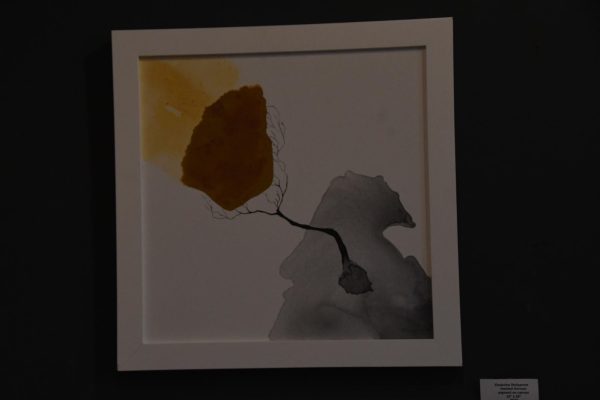
The pieces in Ekaterina Stolyarova’s “Four Seasons: series bear the burden of a very intimate beginnings. Growing up in Nizhny Tagil, a small industrial city tucked away in Russia’s Ural Mountains, Stolyarova honestly thought that water should be brown because of the widespread ecological harm. She described this epiphany as “heartbreaking” because she didn’t realize the actual colors of nature until she was 7 years old and traveling with her mother. Her work as an environmental artist was founded on that break.
Beyond subject matter, Stolyarova’s dedication to sustainability is evident in the materials she uses: Instead of using acrylic or oil, she blends natural pigments with water so that the paint can, in her words, “breathe.” She starts each piece without knowing where the colors will settle or how the layers would interact, accepting the unpredictability as an extension of nature’s own logic. This method reflects her philosophy.
All four of the pieces on exhibition exhibit this surrender to the unknown, with flowing washes of ochre, green, and deep brown bleeding into delicate, branching lines that suggest both fractures and root systems. The dedication of Four Seasons to Nizhny Tagil is a gesture of love and sadness for a city that Stolyarova characterizes as being full of creative and attractive people, surrounded by mountains and woodlands that are worth seeing, rather than a condemnation.
Stolyarova is hesitant to articulate what she wants viewers to remember. She feels that revealing her intentions to a spectator before they have developed their own is akin to “stealing” from them. She describes the subsequent conversation, in which a guest discusses what they found independently, as “the highest price I could ever get.”
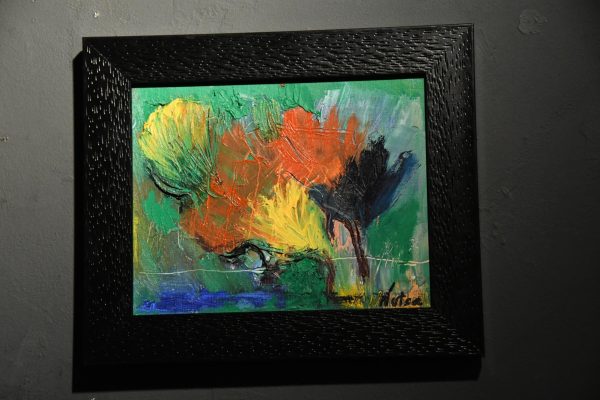 Above all, Nutsa Shanshiashvili is a performer—a Georgian jazz singer whose visual art is incomprehensible without that background. Nutsa, who was born into a family of artists and actors in the Republic of Georgia, says that her music and paintings are inextricably linked and represent the same urge.
Her biggest canvases are used as stage backdrops throughout her performances, with the visual reflecting the narrative of each song. This very synesthetic approach is reflected in the pieces on exhibit at MORA.
The quality of a metropolis is heard rather than seen in early Manhattan, which is depicted in loose, expressive strokes of red, brown, and green with a thin strip of blue sky just visible at the top. It is more of a rhythm than a skyline. The warmth and haze of a city remembered in a dream are conveyed by the large pink canvas, which is thickly impastoed and alive with the vertical suggestion of skyscrapers dissolving into one another. This is exactly how it came to be: Nutsa describes waking from a dream, opening her window, and immediately needing to reconcile what she saw in sleep with what she saw in front of her.
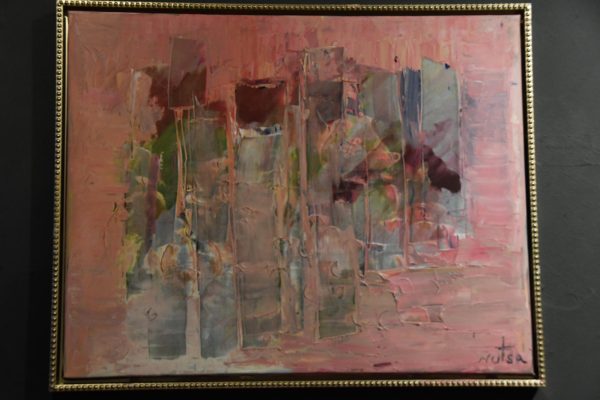 Red Notre Dame de Paris, which is almost totally depicted in flat, fiery red, and Red Tulips, which are bold and delicately delineated in white against a black background, complete a body of work that is more unified by emotional urgency than by formal consistency. The Notre Dame painting is especially significant because Nutsa created it in direct reaction to the 2019 fire, depicting the cathedral in the same hue of what destroyed it. Nutsa’s self-described commitment to love as her main theme is evident throughout the pieces; this is not sentimental love, but rather the sort that honors and refuses to let a city, a flower, or a blazing landmark be forgotten. Like Manoukian and Stolyarova before her, Nutsa gives room for interpretation, characterizing her work as “unexpected” even to herself.
The pieces collected in MORA’s Memoir are more than just a group show when taken as a whole. They form a sort of chorus, with each artist coming from a different part of the world, a different medium, and a different urgency, but all coming to the same conclusion: Taking a close look at the world is an act of wonder in and of itself, whether it be at the ecology of a polluted Russian city, the folkloric dreamscapes of an Armenian childhood, the fractured geometry of a building’s reflection, or the blurred outline of a jazz musician’s Manhattan.
By allowing these artists room, Yelena Kimelblat has put together a display that respects what each of them already understands: that the best work doesn’t dictate how you should feel. It just lets you feel it and lets you figure out the rest.
The MORA Museum of International Art is located at 80 Grand St., Jersey City.