





Even poets who explore drastically different styles can share one mic for a night. On March 31, the Dr. Carl Calendar’s Visiting Writer’s series brought two poets to share their work: DeeSoul Carson and Jeanann Verlee.

DeeSoul Carson is a poet, educator, and host of the O, Word? podcast, with work in POETRY, Muzzle, and AGNI. A recipient of fellowships from the National Endowment for the Arts and the Poetry Foundation, his debut collection The Laughing Barrel is forthcoming from Alice James Books in Spring 2027.
In his own words, Carson’s work aims to be “the interrogation of laughter, joy and absurdity.” His work explores laughing through the Black experience, despite the struggles.
Jeanann Verlee is the author of three poetry collections—Prey, Said the Manic to the Muse and the award-winning Racing Hummingbirds. A recipient of an NEA Poetry Fellowship and multiple national prizes, her work has appeared widely, and she has performed across the country, including with PBS, PEN America, and Lincoln Center.
Verlee exercises activism with her work as well. Much of her work as an essayist addresses issues regarding social justice and animal rights. Her poems aim to address problems regarding mental health, sexual predation, trauma survival, domestic abuse and gender equality, topics expressed in brilliant vulgarity with brutal honesty.
The dinner before the reading was full of spirited conversation and important insights into the poets and their lives. Verlee discussed her experience in corporate life, and how she managed to keep creating during the workday as a manager in investment banking. She then mentions Sema Reza, who got her introduced to a marketing agency that had campaigns to fight social media disinformation, which eventually allowed her to bring her creative side to the table.
In their arrival to poetry, the pair found common ground in unconventionality. Carson fell in love with the unorthodox nature of language, claiming “poetry is defined by what it isn’t.” He expresses his art as “rhetorical estrangement” different than what is typically expected with poetry.
Verlee also shared her fascination with “breaking rules” for poetry, but despite it being “too exciting” to pass up, “you need to know the rules before you can break them.”
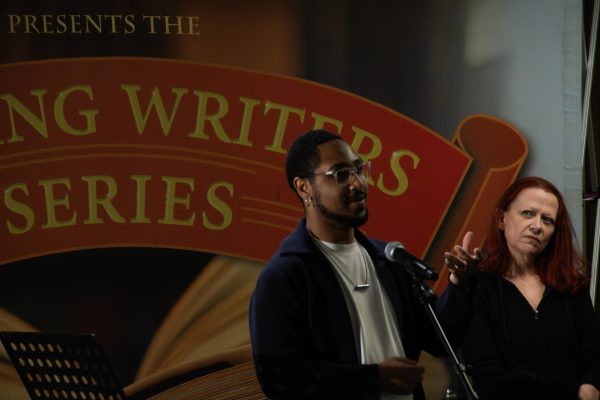
Their styles were drastically different during the reading, but the two poets had profoundly powerful voices. Carson kept the entire session very interactive, with poems from his forthcoming book The Laughing Barrel, a book he’s been working on for years. He encouraged audience interaction, culminating in a mad-libs style poem, as well as a poem where he requested the audience to shout “Mercy!” every time he pointed.
Verlee offered a refreshingly theatrical and brutal position on a variety of sensitive topics. Her dramatic pauses, movement and inflections throughout her reading made the experience much more immersive. Her performance thrived on the simplicity of her prose and the intricacies of her delivery, making the harshest of words and ideas flow with ease.
The poets had varied approaches but shared excellence in their unique styles, bringing their brilliant energy into their performances.
In this conversation, Carson explains his teaching experience, the differences between essays and poetry, and the influence hip-hop has on his style:
Q: You served as an educator at NYU. With any mentorship, the teacher learns along with the student. What have you learned from your experiences? What is easier and more difficult to teach to your students?
A: More than anything, working with students reminds me to have patience and kindness to myself in the writing process. I think it is really easy to be hard on yourself when you’re trying to create something new, and it’s a nice reminder when teaching that we’re all struggling through this together. I think the easiest thing to teach students is that there are many ways to approach poetry, but it is harder to push them toward embracing their own voice.
Q: You are both an essayist and a poet. Is there a relationship between both kinds of writing? Are there times where you find yourself in one format or another? Does each format tend to gravitate toward subject matter, and what are those subjects?
A: I actually wouldn’t describe myself as an essayist, though I’ve written a few essays. It doesn’t come as naturally, and I typically only write one when I’ve been prompted by an assignment of some sort. I recently have been reading a lot more creative non-fiction, which has helped me readjust the way I approach this format. I would say that most of my work comes out as poetry, as it feels like a better vehicle for the kind of meditation I’m attempting.
Q: I listened to the last episode of O, Word? Your conversation with Tariq Thompson kept returning to a lot of subjects, but hip-hop seemed to be a major part of it. You had said during the discussion: “There’s something really deeply connected to tradition in the hip-hop verse.” What about hip-hop most adds to your poetic style? Are there any hip-hop icons today that you can appreciate poetically and if so, who?
A: I mean, more than anything, an attention to sound and rhythm. It’s not enough for the words to make sense; you also want the words to work together sonically in a way that is pleasing to engage with. I would say the folks I appreciate poetically are Kendrick Lamar and Doechii, I am just enthralled by the flow in their music.