














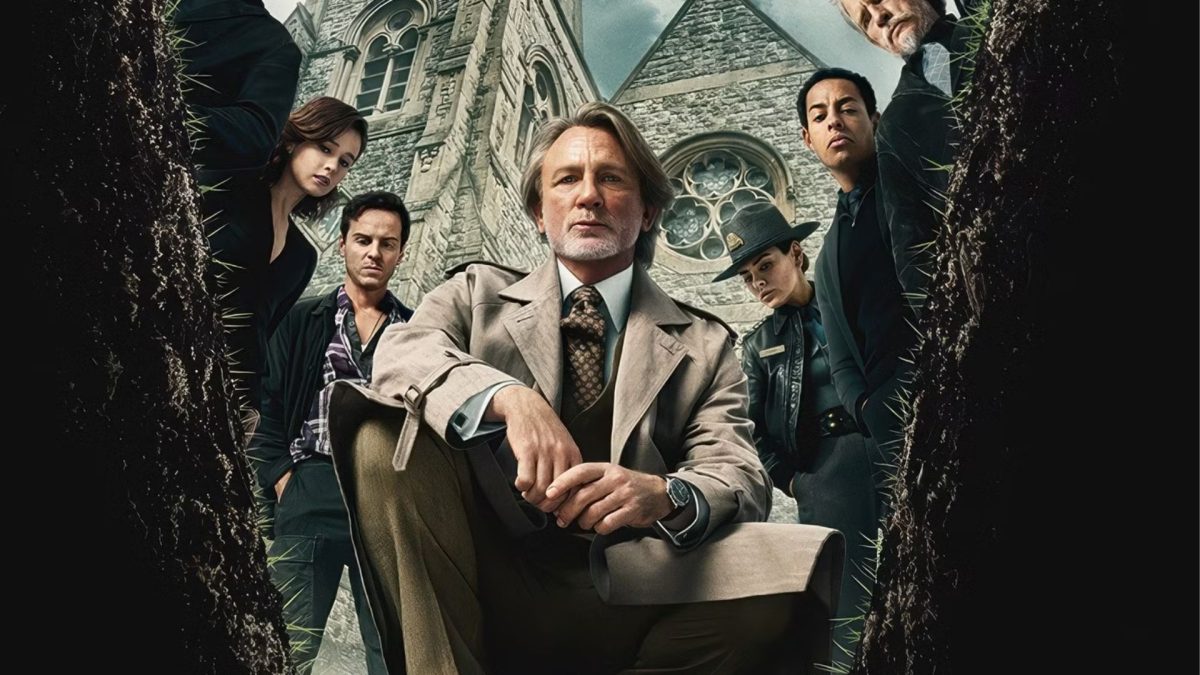
Director Rian Johnson’s “Knives Out” series has officially become a trilogy with its latest installment, “Wake Up Dead Man.” Keeping with the standard of each film tearing at a current political or social trend, “Wake Up Dead Man” expertly satirizes reactionary conservatism and cults of personality.
The film follows Father Jud, played by Josh O’Connor, a priest sent to a remote parish in upstate New York as punishment for a violent outburst against another priest. He is there to work under the senior priest, Monsignor Wicks, played by Josh Brolin.
However, very quickly Wicks reveals his true colors to Jud and the audience, as a man hooked on power and control. The small group of regular attendees to his service, referred to throughout the film as his “flock,” have become so spiritually dependent on him they’ve essentially come to worship him, not god.
Each member of this flock has some kind of deficiency that Wicks promises to fill, whether that be to cure a chronic disease or to fix a broken marriage. He has essentially curated a flock of — quite frankly, losers.
A connection is very easily made to America’s own state of affairs. President Donald Trump, too, has created a cult of personality around him, known by some as “MAGA followers.”
It is at the halfway point of the movie when the audience is reminded of the film’s ties, with the introduction of the now iconic Benoit Blanc, played by the returning Daniel Craig. It turns out there has been a murder in this murder mystery movie, and the victim—Monsignor Wicks.
Of course, Father Jud is posed as the most likely suspect, but in true “Knives Out” fashion, it is the mission of Detective Benoit Blanc to sniff out and reveal the true killer.
Hijinks ensue and by the film’s end it is revealed that the unassuming and jumpy Martha, played by Glenn Close, was the killer all along, a righteous killing to prevent Wicks’s heart of greed from winning in the end.
Much like Blanc’s “donut hole” expression from the first film, “Wake Up Dead Man” has a greater meaning at its center, which requires a deeper look.
As previously mentioned, there is the comparison the film draws to Monsignor Wicks’s cult of personality and Donald Trump’s. They both use fear mongering tactics and empty promises to keep unfortunates who initially may have desired positive change to spiral downward into a pit of hate.
Take Trump’s current pitting of illegal immigrants as the greatest enemy to the American people. He rallies his followers into hating people they have no real reason to despise. Wicks does the same, using his sermons to warn those who will listen of the outside forces that threaten to tear apart their way of life, when in actuality, Wicks and his flock are targeted by no one.
This fearful mentality trickles down to their followers, causing them to become total isolationists, and preventing anyone from trying to pull them out of the echo chamber they have locked themselves in.
The comparison is apt, and Johnson executes it masterfully.
In the end, Father Jud is the one who takes over the parish, transitioning it from a place of hatred to one of practicing his faith, by helping others.
It is Johnson’s way of offering a hopeful ending for the United States, saying no matter what storms it must weather, there will always be those waiting to turn it all around.