












Hindus celebrated Diwali, sometimes referred to as Deepavali, on Oct. 20. Many in the United States refer to this annual holiday as the Festival of Light or Festival of Lights.
Many people also associate this holiday with the conclusion of the Hindu epic Ramanaya, a foundational text in Hinduism. In Ramanaya, Rama, an incarnation of Vishnu, defeats the King of Lanka, Ravana. This tale is often viewed as the triumph of good over evil, or light over darkness.
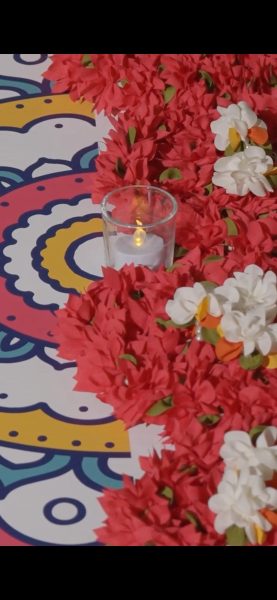
Celebrating the holiday entails lighting deepams, or lamps or fireworks, and colorful displays. Families get together, exchange gifts and sweets, and make Rangolis, which are colorful designs made with dyed sand or rice powder. Regional differences also exist: Southern Indians often take warm oil baths for purification, while North Indians worship the goddess of wealth, Lakshmi. Some parts of India will also associate the 5-day festival of Diwali with the start of the new year.
Many practicing Hindus will associate other virtues with the auspicious holiday. That message was showcased at the Diwali event hosted at Livingston Hall at Rutgers University, on Oct. 27. Upon entering the room, the hall was lit up with cool colored lights in blue and purple. The main stage and audience was surrounded by warmer, ambient light in orange and yellow.
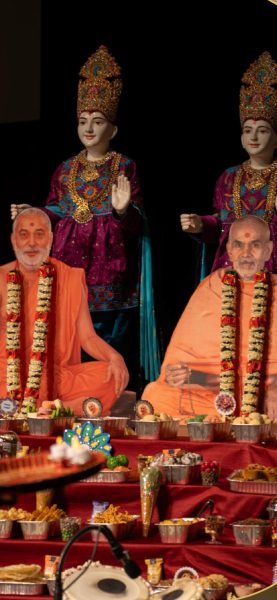
 The walls were adorned with matching colored garlands, and on stage, there were traditional instruments, like tabla, played by musicians, and cutouts of swamis, or religious teachers, situated in the center. The swamis were surrounded by annakut, or various offerings including food not traditional to Indians, such as chocolate chip cookies and blueberry muffins, but also mainly traditional Indian food, such as fried dal (lentil stew) , Pav-Bhaji (bread with spicy vegetable stew), Halvasan (a traditional Indian sweet made with ground wheat flour, milk, ghee and sugar), and Samosa (fried savory, flaky pastry with spiced vegetable filling, usually including potato).
At Rutgers, about 300 people attended. Most were students trying to connect with the holiday customs.
Part of the atmosphere was also the music, which included the aforementioned tabla, but also videos of musicians playing violin and harmonium. The tabla is an instrument that provides rhythm, and the Dhun (devotional song), Prathana (Prayers), and Kirtan (chanting of mantras), or hymns alongside the beat were complemented perfectly. The violin and harmonium were excellent in providing the melody that gave the event with light energy and peaceful evocations. The hymns themselves reflected devotion toward Rama as well as another incarnation of Vishnu, Krishna.
Perhaps more interesting was the tone of the event in general. The organizers framed Diwali as a “Festival of Forgiveness,” and many speakers reflected this sentiment. During the Ramayana, Rama is constantly faced with opportunities to act in vengeance. His initial exile from his kingdom, Ayodya, was a direct violation of his birthright to the kingdom. Instead, he was banished from his empire for 14 years.
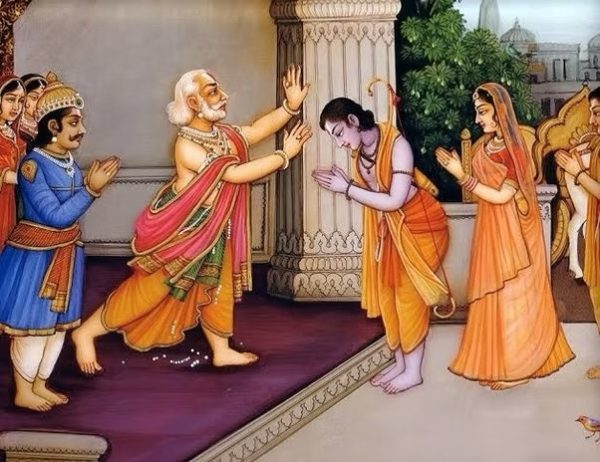
 Yet Rama held no grudges toward his father, kingdom or his father’s wife Kaikeyi, who according to the story, was the one responsible for Rama’s exile. During exile, Rama’s wife Sita is kidnapped by Ravana, and this triggers a war from Rama’s army and Lanka. During battle, Rama carried out funeral rights for all the asuras, or demons he faced. To him, they were beings that were deserving of honor and ritual in their deaths. Even in his final battle with Ravana, Rama offered the demon king mercy and the opportunity to seek refuge.
Rama’s forgiveness, according to event speakers, is through icons throughout history. Speaker Vansh Patel spoke of self-forgiveness through the lens of the story of Micheal Phelps, whose mistakes throughout life never took away from his greatness, and how that was largely due to his ability to forgive himself.
The speaker Raj Patel spoke of forgiveness through the lens of Nelson Mandela’s story. Mandela forgave his previous oppressors without holding a grudge. Pujya Kaushal Nidhi Swami spoke of Nishkul Anand Swami, who preached much about forgiveness in his teachings.Swami said, “No weapon is as powerful as forgiveness. No mantra is as powerful as tolerance. No shield is as powerful as patience. No retaliation is as powerful as silence.”
In speaking with Vansh Patel, who had spoken at the event and involved in organizing, this exhibition meant a lot to the local community, and involved a lot of selfless volunteering and preparation. He mentioned that they don’t often hold events in a college setting at this scale, and it took a lot of effort from volunteers.
Patel attributed the success of the event to “preparation and heart,” as well as bhakti (devotion), that helps people set up, set aside time for the event, make food and decorate.
The Bochasanawasi Akshar Purushottam Swaminarayan Sanstha (BAPS), who were the event organizers, aimed to make messaging regarding Diwali more accessible, and Diwali more open to the public. You don’t even need to be Indian, and everyone can feel like they’re part of the event. They intended to make a memorable first experience of Diwali and make everyone feel welcome, which they certainly achieved.
The end of the event involved the attendees receiving food, specifically Pav Bhaji and Samosas, traditional Indian snacks. As an event as a whole, BAPS gave a unique perspective on such an important holiday by highlighting the importance in exonerating ourselves and others.