













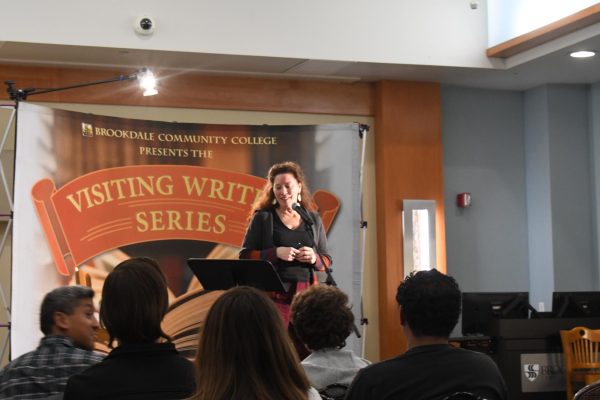
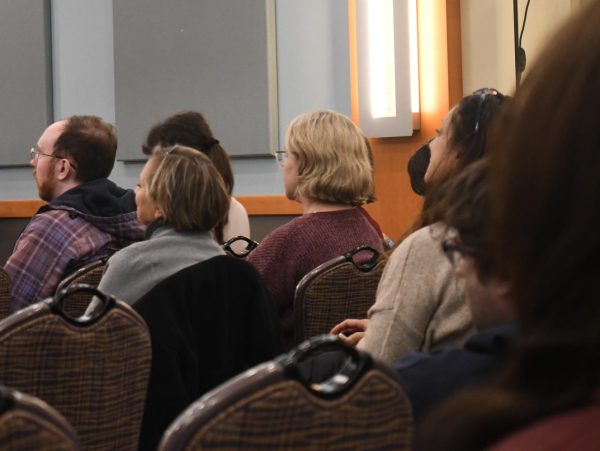
Reading from his novella, “On Remembering My Friends, My First Job, and My Second Favorite Weezer CD” during a Visiting Writers Series Event Nov. 11, author Francisco Delgado weaved together a story about belonging.
Any student who has felt alienation in their formative years, particularly because of their cultural background, might see themselves in this painful, memorable story. With rather simple, elegant prose, Delgado spends time developing his characters in a way that really contributes to the overall tone.
 Dr. Carl Calendar, who founded the writing series, was in attendance at a dinner ahead of the reading. He explained how the traditions surrounding the series have changed to be more centered around giving the students in attendance a unique experience, lending itself to be much more beneficial to aspiring artists.
At dinner, the conversation included many insights from students, staff and Delgado himself.
The writer emphasized many things, as well as being a community college professor and how that work differs from his creative works.
Delgado describes academic work as viewing conversations and works as “models,” whereas creative writing allows for more experimentation, with less need for structure. He also indulged students with how he balances the two, explaining how he writes with students for their assignments, helping him generate his own material by “living struggles” with his students.
Delgado discussed some of his future goals, including writing a book and translating the work into CHamoru. The Chamorro people are a prevalent ethnic group of the Mariana Islands, especially in Guam. The group of people underwent a diaspora largely due to the U.S. military, and are believed to be Indonesians who traveled to the islands around 1500 B.C.E.
Because Guam is a U.S. territory, the Chamorro people largely are protected as commonwealth citizens of the United States typically are. The CHamoru language was once repressed, and many considered the language to be lost, largely due to Spanish and then U.S. colonization. Delgado humorously referred to his Chamorro identity as his “gimmick,” comfortably making light of an aspect of his identity that he holds in high regard.
As for more thematic topics, Delgado emphasized his approach to novels centering around character development. He said he often goes on walks or engages in his community to get over moments of writer’s block.
What follows is an interview with Delgado, a proud Chamorro writer and educator whose work traverses through memory, identity, youth and cultural belonging.
Delgado explained that he is of Chamorro descent through his maternal grandmother and a member of the Tonawanda Band of Seneca. He brings to his writing a richly layered perspective rooted in indigenous and Pacific Islander identities.
This interview focuses primarily on “On Remembering My Friends, My First Job, and My Second Favorite Weezer CD,” a novella published by the Texas Review Press. The novella won the 2024 Clay Reynolds Novella Prize. It navigates the life of Cody Taitano, a mixed-heritage teenage Chamorro and Native American living in upstate New York circa 1999. Taitano’s first job at McDonald’s and an encounter with policing crystallizes his reflections on race, class, friends, fatherhood and music.
When did your passion for writing actually develop? Was it early on, or did it manifest itself in later years?
Yeah, I started writing seriously as a hobby when I was in middle school, which is a very difficult time, I think, for a lot of us. And so, writing was, as I have said elsewhere, a way for me to explore my feelings and my emotions going through this very difficult time for me socially with my family life. So, I started writing then, and it’s just something I’ve always done. It’s almost like a way for me to just catalog what is going on in my life, what questions I have, what issues or themes I wish to explore. So, this book is very much an exploration of cultural identity, what it means to belong, what it means to actually look after and love each other. So, Cody’s family is a huge part of the novella, and there are times where, according to him at least, they fail him. They leave him to his own devices too much to figure things out on his own.
But there are other times where his family, his friends pick him up. So writing is just a way for me to kind of explore, in this context, the importance of family and friends to just help us figure these things out for ourselves.
The main character in this novel, Cody, (without revealing too much) kind of draws a parallel between his experience in the COVID-19 pandemic and his experience as a high school senior. And you touched on this slightly in the book, but what do you feel are some thematic parallels between the COVID-19 pandemic and your experience as a high school senior? And how much do Cody’s feelings about this relationship really reflect on your own?
So, this is definitely a part of the book that is somewhat autobiographical. For Cody, the time period of like 1999 and the time period of 2020 are both times marked by isolation, right? During COVID-19, we had to isolate. And for Cody, as a senior in high school, he felt kind of isolated from the world. He is so close to graduating. He sees college on the horizon, and he’s desperate to get out. Similarly, in 2020, as a dad, he is, you know, desperate for the world to reopen, to be able to go out and have a meal with his family, to take his son to a play space or to have his son have a birthday party, right?
So, I think those are the emotional connections of those two time periods. And regarding the plot of the book, what kind of connects the two time periods is the discovery of that Weezer CD. When he and his son are playing hide and seek, his son finds this Weezer CD and that just brings Cody back to 1999.
So your book was published in 2025 and was really bolstered by the Claire Reynolds Prize Award. What was the process involved in negotiating the royalty contract? Because I think a lot of people that want to break into writing would like to know. And how is this specific publishing process different from your publishing process for “Adolescence: Secondhand,” which I believe Honeysuckle published and was kind of an indie publisher more so? So how would you compare the two processes?
Yeah, they were both similar in that they were both contest-based. So with “Adolescence Secondhand,” I was the runner-up for their fiction prize. And for the Claire Reynolds Award with Texas Review Press, I won their Claire Reynolds Novella Prize. So, they were both based on contests and winning or being runner-up in those contests. Regarding the negotiation of royalties, there really wasn’t a whole lot of negotiation. As you could expect from an indie publisher, their means are limited. So, it was really just like, “Oh, we’ll see.” And I was like, “Great, we’ll see then.” And with the University Press that I’m currently working with, they make it known when you enter the contest that you get $1,000 when you win the prize and that they will promote your book on all their social media platforms and in their areas. And they’ll nominate your book for other awards and help you in that way. But again, there wasn’t much negotiation with royalty.
You come from a very unique cultural background. Obviously, we touched it just now. I think the average person may not know where Guam is or what Chamorro culture is. And growing up with a unique background in America, and as a result looking different from your peers, I think, it can be potentially very alienating. And the main character in this book, Cody, at the very least, feels alienated from a lot of his peers, mainly due to how he looks. But I, at least the way that I read it, kind of felt like his connection with his culture was through his grandmother. And I think that connection wasn’t really established as more than that and his connection to other figures that he’s seen look like him. Can you talk about your connection to the Chamorro culture and if it’s been something that’s always been a part of your life? Were you always proud Chamorro? And how did that affect the way you felt in your youth versus now?
Growing up in upstate New York, it was a predominantly white area. And being a brown-skinned, indigenous young man, my race and culture were often used against me. And it took many years for me to embrace it. It was something I was always proud of, albeit maybe in a more understated, insular way. But to be outwardly proud of it is something that took me years to get through. And it was actually in my college studies and my own creative writing that helped me realize the power and beauty of my indigenous background and to celebrate it in my writing. And it’s a responsibility that I embrace. So, whenever I’m in a space where I am the quote-unquote indigenous writer or Pacific Islander writer, I’m very quick to also mention that I’m not the only one. Yes, it makes me unique and maybe special, quote-unquote, in a certain way, but all of our cultures are unique and special. So I want to always promote other writers of Pacific Islander backgrounds or Chamorro cultural background to let readers know that it’s not just one of me or one of any of us. We’re always all a multitude. There’s so much diversity in all of our perspectives.
The book is so quotable. There’s an amalgamation of painful and yet relatable quotes. Can you talk about how you maintain your mental and emotional health while writing this? Did you view this book as more therapeutic or exhausting, and how did that help or harm your writing process?
Yeah, so I think my mental health was very much tied into my writing of the novella. So, it wasn’t something that got in the way of my mental health. It was something that was an active part of me maintaining that part of myself because I am exploring questions in this novella that I think we all kind of struggle with, like where we belong, who we belong to, how we can use language or art or writing or whatever to really celebrate the people we love and the culture that we come from. So, for me, it was always just a matter of, you know, my mental health was linked to me continuing to write this until I felt I had it done correctly. Oh, I also do appreciate your comment about being quotable.
Your fondness for professional wrestling is very prevalent in this book, and in a lot of other works you’ve referenced it, and it continues to be referenced in your writing. In the book, it’s mainly through The Rock, and you reference The Ultimate Warrior, Ric Flair. And in an interview, you had about “Adolescence: Second Hand” you said you admired the blending of genres taking place, especially recently in the performances made by professional wrestlers. So, can you talk about the idea that influenced your writing for this novel and how it continues to interact with your future pieces? And besides The Rock, which wrestlers, past and present, stick out to you as stories that blend genres, and why?
Yeah, so one of the things that I loved about The Rock was when he first turned heel or became a bad guy, one of the things he started to do was as he was beating up his opponent. He would grab the headset off of the commentator and do commentary on his own match while he was beating up his opponent. And I thought that was hysterical. But it was also very meta, right? He’s doing commentary during a match that he is also participating in. And I thought that was the coolest thing. So, he’s somebody that always looms large in my mind as a model of what a minority can be allowed to do and the ways that they can transcend those expectations. Because of The Rock, some people might not remember this or know this, was not supposed to be cheered. He was supposed to be a bad guy that we booed, and that was limited to how high he would get. But because he was so good and charismatic, he transcended those circumstances.
Are there any other wrestlers that kind of reference that idea of blending genres within their stories?
I can’t really think of any, honestly. I’m very fascinated by the boom of indie wrestling that happened in the 2010s, because there we saw wrestlers use platforms like YouTube and Vine to promote themselves in a way that was very novel. So, it was almost like this blurring of two worlds where sometimes they were their gimmick or their persona, other times they were themselves. And it was all to get themselves more bookings as a professional wrestler. So, if there’s something I would probably want to explore more in a future project, it would probably be an independent wrestler in the 2010s who is using these new social media platforms to promote themselves while also kind of maintaining their gimmick in a weird way.
The Q&A session after the reading also provided interesting insight. Here are some of those questions and answers.
If you could tell your high school self anything from what you’ve experienced, what would that advice be?
Growing up, I was very geared toward getting as far away as possible from my hometown. I wanted to go to California for college. I loved the idea of going to San Francisco, because I read some beat riders, and I thought they were just, like, the coolest. And so, I saw myself moving to San Francisco, where I also had some family, and just, like, living this life as a writer. So, one of the things I would tell myself, I would tell him to stop watching so much professional wrestling. I could, you know, it’s fun, but it’s not going to get me anywhere. I would also tell him that you don’t need to go so far to find your people. Um, I went to a state school in New York … I found my people. I found my people in English classes, creative writing classes. My classmate, who became my wife, we were in a class called “Short Story” together. And, um, she constantly bailed me out when the professor knew I didn’t do the reading. And we’re still bailing each other out. So, that would probably be the primary thing I would tell my younger self, and this is something that Cody’s grandma also tells him, and then, uh, you don’t have to go as far as you think to find your people, your people are close by. You just have to make yourself known, and you’ll find each other.
Did you get a lot of “no’s”?
Oh, I got all the no’s. Nothing, you know, it’s one of those things: You get nothing but no’s, but you only need one yes, right? …So I just kept submitting it to contests, to agents who were radio silent, which is usually, you know, as you can guess, a sign of no interest. But I just, you know, stayed stubborn. I knew the story was developing in a way that I felt very comfortable with and very proud of. And I just had to ignore the no’s, even as they kept piling up. I don’t know if in your classes or in your own writing careers, if you all have started submitting your work, or if you’re familiar with a website called Submittable. My submittable page in a way … kind of filter in their submissions. My submittable page is, like, so many declines. Like you have accepted, declined, and I think withdrawn. Those are three tabs. My accepted tab is like five or six. On my decline tab, you have to literally scroll down and then go onto another page, scroll down, go onto another page, scroll down. Just the nature of things, but, you know, you used to have to hang on to that, you know, kernel of what made you first write this story. And that’s gonna kind of, hopefully, pull you through.
On dealing with microaggressions and it’s contribution to identity:
Yeah, so microaggressions are powerful things, right? It’s not the same as, you know, getting punched in the side of the head, like Cody gets in this opening scene. But its language, and as we all know … like language can be weaponized and brutalized in very marked ways. So, I think for many of us, but for myself, I can speak for myself, having to deal with my aggression so often growing up, it does make you second guess celebrating who you are and celebrating your culture and your family. And it takes many years for a lot of us to come around to that. And a huge part of me coming around to celebrating my culture is writing. I was able to articulate why I think there’s beauty and power in my indigenous background in a way that I didn’t feel comfortable verbalizing when I was growing up. I remember being very, I don’t know some might call me, some members of my family like to describe me as shy… You know there was an inner strength there. I did feel strong and competent in some ways, but just not in ways like that. I couldn’t really articulate or share just yet, so writing was my outlet, and writing is still my outlet. It’s a way to kind of take some of that language that was used against me and my family members via these microaggressions and make it part of my own story in a powerful way.
What are some of your favorite books?
I love that question. That’s one I get asked a lot, and I think it’s because I’m up here, right? So, it’s like, oh, you’re a writer, so you obviously have read a lot of books. What are your favorite books right now? My answer is always …. My favorite book of all time is “Love Medicine” by Louise Erdrich. She is a turtle mountain band of Chippewa, Native American writer. Her novel … is an intergenerational family story. Each chapter, some of which are anthologized as standalone short stories, but each chapter is narrated by a different member of the family. So, you get this understanding of each of these characters, but you then get more of an understanding of them when you see that same character through the eyes of their family members. So, tensions where it’s like, “Oh, that character is just a jerk..Then you get that jerk’s perspective, and you’re like, “Oh, maybe they’re not so much of a jerk.” …But that is easily my favorite novel of all time. I’m a more contemporary novel that I’ve really loved, and I love teaching is There There by Tommy Orange, which is structurally very similar to love medicine. Each chapter is narrated by a different character, but in Tommy Orange’s book, each character is headed toward a big powwow in Oakland, California. For those who don’t know, powwow is a gathering of many native communities, native tribes, and they have dance competitions, and there’s native food, and a lot of native artists and jewelers… Those novels, do something that I think is very important when you are writing about a native or indigenous background. Because when you’re native or you’re indigenous, some folks are very quick to pigeonhole you as one thing. Like, “Oh, you’re native. You grew up on the reservation.” No, I grew up in a suburb. “Oh, you’re native, or your family’s from Guam, when did you move here?” I was actually born in Germany because my dad was in the military, and I moved here when I was 2.” … So I think one of the things that we always have to do as indigenous writers, but what we all have to do, is … always kind of show that there isn’t just one story for one community, right? So, Erdrich does that in “Love Medicine.” Orange does that with “There, There.”… Whatever you think of as this singular thing is, in fact, a multitude, right? And I think literature … can make that point quite beautifully.
Anilkumar Nair • Nov 18, 2025 at 9:46 PM
Great work, really enjoyed