













When an author, especially a poet, is referred to as the “greatest alive,” it’d seem natural that they’d feel a lot of pressure to act a certain way. Chicago’s own Patricia Smith, especially in her visit to Brookdale’s Visiting Writer’s Series Dec. 3, was unapologetically herself in the most authentic way.
Her prose is not only incredibly ornate and specific to her culture and background, but also resonates with a wide audience and particularly with African-American women.
Invited to speak by Professor Suzanne Parker, Smith discussed her new book of poems, “The Intentions of Thunder.” The collection grippingly portrays the realities of life, pain and joy in a raw, yet tasteful way. The word professional critics often use to describe the poet’s writing is “lyrical.” Smith acknowledges the influence of Motown music and Chicago-based themes on nearly everything she’s written.
Smith attributes her gift of storytelling to family tradition. Coupled with her unique meter and unmistakable cadence, her voice helps breathe life into her truly unique stories.
At a dinner before the reading, Smith shared insight into her writing. She insists that a big part of her process is considering the unknown, and she noted that a story changes based on how it is told. The poet said she challenges herself to see how an already established story can be explained and written differently than it historically has been.
Smith said part of poetry is creating a “fishhook.” In other words, she said one of the many attributes of a poem ( story, prose, cadence, rhyme scheme, etc.) is the proverbial “bait” that lures an audience member into the poem.
Smith emphasizes the importance of tension in setting the tone of her work, how it can make a horrible story beautiful. She explains that she works to be a better reader of her work, as her readings are more theatrical and authentically performative than most. Smith implores poets to read out loud, internalize their work, and concentrate on their own sound to figure out their own individual rhythm.
Smith said the book of poems “Here, Bullet” has served as great inspiration for her. The poems included capture the visceral and devastating feeling of soldiers and civilians alike in the Iraq War.
She called poems a “receptacle for emotions” and said negative emotions tend to help with her writing process. Smith said writing about her melancholy helped her work through it and eventually begin to heal.
Clearly, Smith left an impact on all the students in attendance, with gripping poems that were painful, raw, and emotion-filled, yet so pleasing to listen to in a way that felt unique to her experience and style.
“I’ve read some of her work, and they’re amazing,” said Luis Merino, a 23-year-old creative writing major. “I read a Hurricane Katrina poem, one of them.”
“She’s such a great spoken poet,” said Emelia Stedman, a 29-year-old science student. “I was learning from her, like how she performed, how she presented her work….(I) paid attention to her meter that she mentioned that she had a natural meter. So how she starts with a stronger tone, then slows down, then a strong tone again… She has a meter that will probably get me to focus on my own (meter).”
All in all, Smith’s voice and unapologetic nature made her subject matter pop more than it already does. Her stage presence was a breath of fresh air from other poets, and her quips and jokes showed how seasoned and comfortable she is as a performer. She has great use of alliteration and very vivid imagery, but her authenticity and reference to real-life events and personal experiences made her stories all the more powerful.
Patricia Smith shows how a few words can spin a prettier yarn than most.
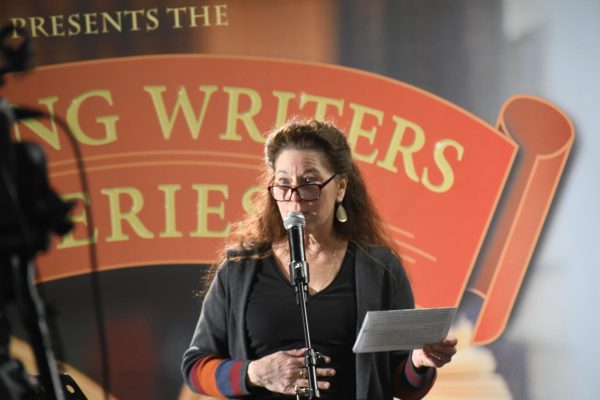
Professor Suzanne Parker introduced Patricia Smith’s reading.
Smith granted The Current an interview prior to reading. Here is what she had to say:
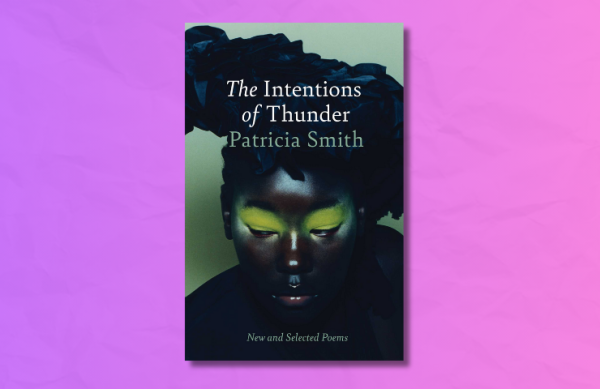
The book cover really stood out. And the title (“The Intentions of Thunder”) in general. So is there an intentionality behind the title or the cover at all? Or a meaning behind it? Is it just something that you liked the way it looked? Or is there a cultural undertone to it?
The title…Thunder can warn you. It can frighten you. It can resound. It can crack and go away. So, like poems. You know, poems can affect you in a number of ways. And so that’s the initial thing I thought about. And then I looked all over. I looked for art with not thunder, of course, but lightning in it. And none of that was working. And so I decided I’ll just get some very serious, thunderous pieces. And it looks like an, she looks like an approaching storm to me. So I had about 5 or 6 pictures and eventually I couldn’t decide. And so I asked my publisher to help me out this summer.… Yeah, you want people to pick it up.
I think a lot of students want to get a break into creating books, novels, poetry. How did you get started in poetry? Were there local slams? When did you start writing?
No, it was because my father was part of the migration up from the South to the North. So he moved from Arkansas to my hometown of Chicago. So one of the rituals that he brought with him was every day he would sit down after dinner and just tell a story. Sometimes the story included people that he worked with – he just made me think that there were other ways of looking at the world besides what I was or was not learning in school. Other ways to look at people, what people did. He would point out and say, look, there’s somebody with a grocery bag. Where do you think they’re going? Where do you think they’re coming from? What do you think’s in the bag? You know? So he was always trying to push my curiosity. And so I started thinking the best thing in the world is to be a storyteller because you wake up every morning, the slate is clean, and you just fill it with life. So I wasn’t thinking at that time I’m going to be a poet, but I knew I wanted to do something with words. I’d say it started when I was like 7 years old.
Of course a lot of people call you the greatest living poet, that’s something that people do call you. A big part of what you, what I’ve noticed was the importance of voice and being able to project that, that tonality into a poem. So, can you speak to that? Can you speak to how important it is to perfect your voice and kind of make it a performance?
Yeah. It’s very important. There are a lot of poets I have discovered in other ways. Like I pick up their books and go, oh, this is great. I can’t wait to see them. And what you do is you kind of think of the poem with the voice you think they might have. And then there’s been a lot of times I’ve done that, and I’ve gone to see a poet, and they don’t look interested in their own work. And I think all that is important. You’re not just… You’re there to pull the audience into what you’re saying. You’re there to say, here’s a really interesting story. I bet it’ll be interesting to you, too. And you can’t do that if you’re not even acknowledging that they’re there… Every once in a while, look up… I’m trying to get people to feel what I’ve felt before I wrote it. This is what led me to write this poem because of this… So I think it’s really important to get that energy and show the audience that you’re still involved in what you’re doing.
You started your career in journalism. A lot of your professional public work was front-facing work in journalism at first. Are you a photo journalist by chance? Your work seems to center around photos and you seem to have an eye for it.
I am a really good photographer, but I’m not a photographer. I used to hate it when, remember the Wild, Wild West of social media where I just put a picture up .. And people put pictures up and they edited. So I had a friend of mine. He said, I’ve been seeing the stuff that you’ve been posting. He said, you have a really good eye. So I bought myself a camera and, you know, and I really like it. And I love working with photography… I have a book where a photographer who had taken pictures in 1970s dance clubs in Chicago had all these photos and they wanted some text to go with them. And it was one of the, it was one of the best things for me. I loved it, loved it, loved it. So I love working with visuals, and I love to get into the topic a little bit more when I have time.
I think I saw an interview with you where you were talking about one … a collection of, like, unidentified African Americans.
That was another book. Yeah. That was, I collect, um, I collect 19th century photos of mostly African Americans. And so I did a book called “Unshuttered.” I did a book where I would assign voices to some of those pictures. Actually, that’s the whole book. So I’m visually tuned in a lot.
A lot of your work has to do with the Black experience. And specifically womanhood and the Black experience. So how much of that is based in reality? How much of that is stuff that you’ve actually gone through, stuff that have you seen people go through?Are there elements of it that you pull from real life?
Yeah, I think everything, like I said before, especially when you first start writing, that’s all you’re pulling from. It’s like, here’s something that happened to me. Here is something else that happened to me. And then as you move outward, you get people who start to tell you their stories. And you can incorporate that. I wouldn’t say, oh, I’m writing about the Black female experience completely, but almost every time (I’ve read) there’s been a woman, an African American woman, that connected with at least one thing that I’ve read about, or knows about another person like that.