












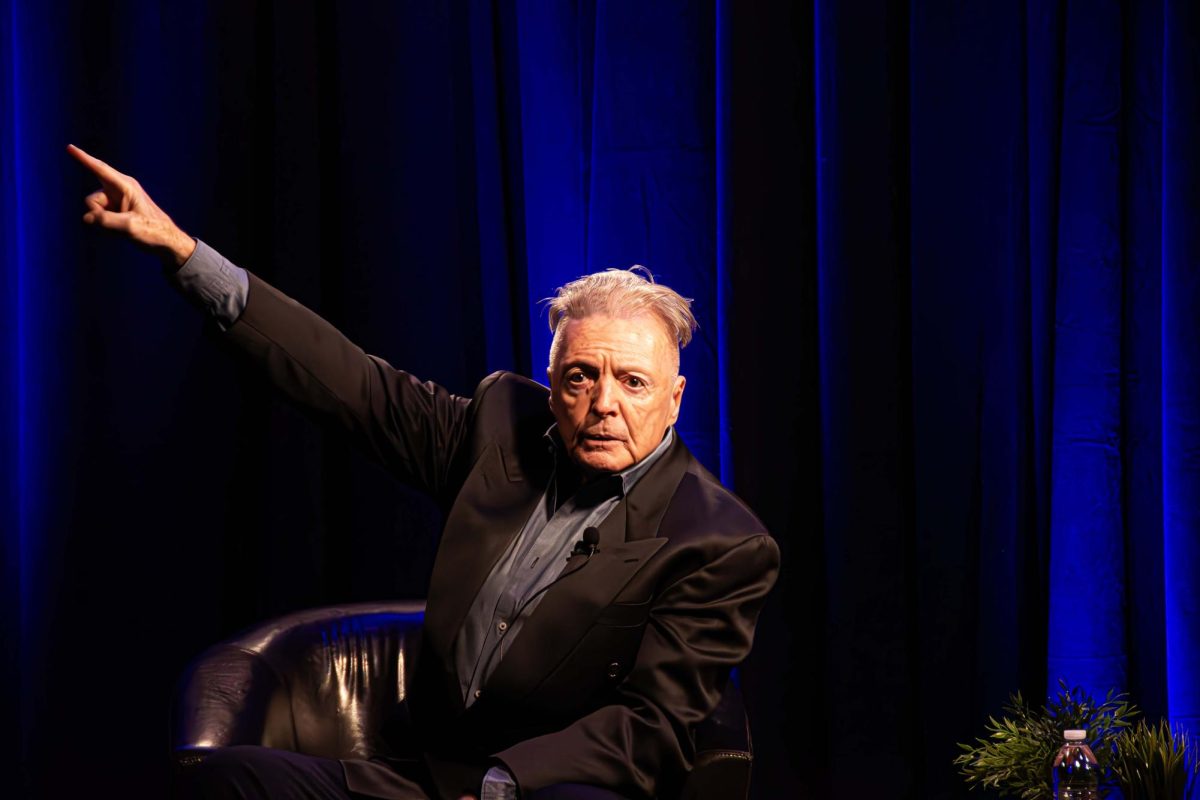
Emmy Award-winning actor Armand Assante sat down for a conversation with Monmouth County Commissioner Tom Arnone for a conversation in the Navesink rooms before a crowd of students, staff and fans on Jan. 28.
Presented by the New Jersey Film Academy, the program, which provided many gems for listeners, gave the audience a chance to learn from a master of his craft.
As decorated and achieved as the actor is, whether playing the infamous New York mobster John Gotti, or his theatrical performance as Odysseus, he is clearly someone who is loyal to the craft. Assante is not only a Hollywood A-lister, he also spent in theater.
“Writing is fundamental, not only in film, but everything,” Assante said, noting that it is the core of his performance when he creates a character. While he said about “20 percent” of the scripts he reads needs more writing, he said the screenwriter’s or author’s words become part of his DNA as he develops each character.
“I want people to connect with me,” Assante said. “It was a strange kind of a progression that I knew I wanted to be an actor from a very early age. My parents brought me to Broadway musicals when I was 4 years old. So I had this, I was stricken with the magical theater.”
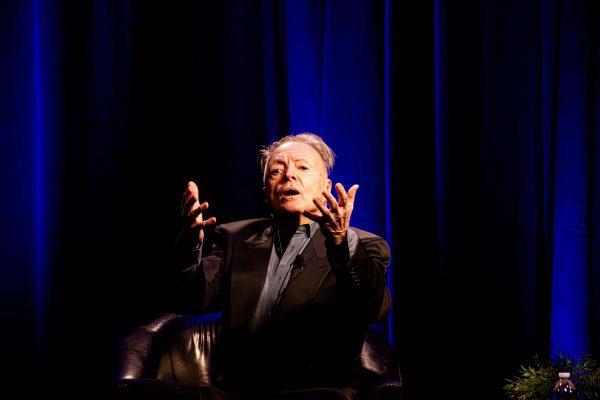
Assante’s time in theater was followed up with his first role in Hollywood, as a guest on a TV series. He said he immediately noticed the contrast between his thespian and commercial experience.
“They don’t have time on a film set for your problem. They don’t have the money. It’s economics. They do not have the kind of money for you to try to process your work. They expect you to come in, hit your mark,” Assante said, adding “it’s not impolite.”
However, he said he has always had a commitment to better representing each character.
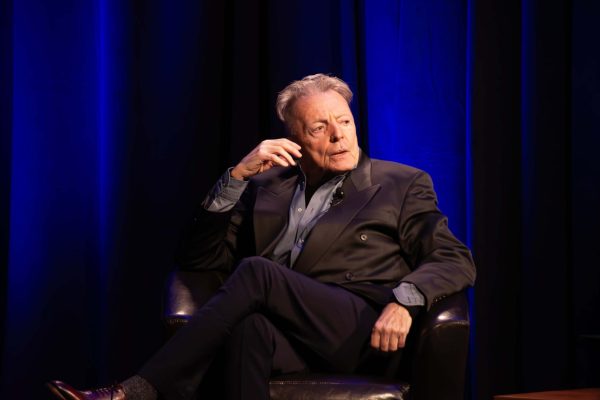
Assante said he made with a tough decision in the name of artistic integrity and faced with a $33 million lawsuit after a disagreement with a script. He said this him on a journey across the world of independent films, which made him aware of the talent around the world. This background also led to a better understanding of how fortunate filmmakers are in the U.S.
“The entire world wants to be in this room. And that’s the beauty of this country, what this country’s managed to do. We actually have permission to make films that are not censored. We have permission to do this amazing work.”
“The event offered an honest look at the realities of an early career in the film industry—from the risk of leaving a major agency to the uncertainty of independent work,” said Elliot Gaffney, a 27-year-old New Jersey Film Academy student.
“His advice to upcoming directors —’make it personal’— stood out most. ‘When you truly care about a story, that commitment shows on screen, and the audience feels it,'” Gaffney said.
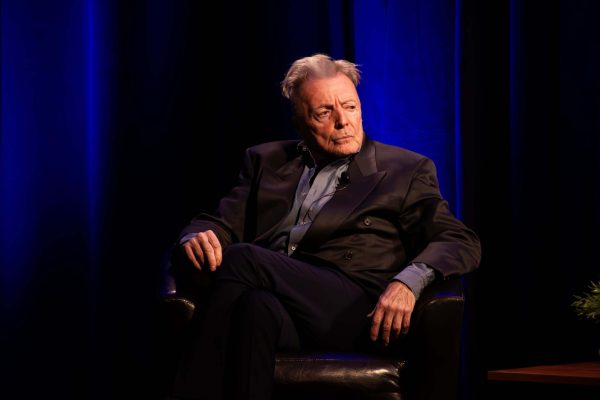 Here is the Q&A section of the evening:
Q: I’m in the production office and accounting track, which may not be as creative as some of my fellow students. You’ve done a lot of independent projects. How hands-on are you as a producer with production office jobs, and what does that involve for you?
A: That’s a very interesting question. I’ve silently produced a lot of films. I’ve had representatives, but I was never deeply involved in that part of the process. Now I’m running a company I founded, and I can tell you, it’s formidable. It’s not my field, so I consult with a lawyer constantly to make sure the accounting is meticulous.
This is a major problem in the film industry: a lack of accountability, a lack of precision, and a lot of sloppiness. I thought the mortgage industry had problems—the film industry is worse. As a producer, I will always hire an extremely astute production supervisor.
People don’t always realize the structure. The producer finds financing. The executive producer is usually the financier. The line producer runs the production day-to-day, and the production supervisor coordinates constantly with them. Those are the people accountable to me, and clean books are super important.
I’ve left two productions with major agencies because I saw dishonesty. This problem has existed throughout the history of the film industry. God knows what early Hollywood accounting never reported.
Q: When you’re developing a script and you notice loose ends, do you ever go off-script or improv during dialogue?
A: I don’t usually improv, but I do confront unresolved issues. If a character hasn’t been fully researched or something doesn’t make sense, you have to bring it up, especially if you’re front and center playing that character.
Film writing is one of the hardest forms of writing. It’s a kind of poetry. It’s about behavior, and often about what isn’t said. If you make changes, they must serve the story.
The brilliance of a screenplay is logic. If logic isn’t there, the audience won’t stay with it. That’s what I look for constantly. Writing is the most delicate part of filmmaking. Everything starts there.
Q: You were in “The Road to El Dorado.” What was that experience like?
A: It was very interesting. Jeffrey Katzenberg produced it—one of the most successful producers in Hollywood. There were about 30 writers in the initial sessions, which completely blew my mind.
The film was made in very small sequences. They’d perfect one, throw it out and redo it. A lot of the writing happened day-of, which put strain on the production, but the cast was phenomenal. I’d love to do more animation. I’m actually developing projects now with animated elements.
Q: What’s the most important acting advice you’ve ever received?
A: I once worked with Sidney Lumet. I felt disconnected in a scene and asked him what was wrong. He said, “Lean forward six inches.” That small adjustment created an immediate electrical connection.
Sometimes it really is that simple. But I’ve also worked with directors who didn’t do enough homework. As an actor, you need to know the character inside and out. If the director doesn’t understand the scene, ambiguity becomes your responsibility. You have to use it. Sometimes something emerges—and sometimes it doesn’t, which is terrifying.
Q: How do you protect your artistic instincts when there’s pressure from directors, producers and studios?
A: If you truly know your material, you gain internal authority. You don’t have to be disrespectful, but you do have to claim that authority.
Most failures come from lack of preparation. If people had the money, they’d rehearse for weeks. Preparation is what’s missing in this industry.
Fred Astaire once said, “I do not want my audience to bear the burden of my effort.” He rehearsed endlessly in private. Charlie Chaplin was the same way—he needed privacy to reach completion.
Love failing. Love not knowing. But preparation is everything.
Q: What role did you relate to the most?
A: Ironically, it was a film I shot last year where I spoke French for most of it. The character was a university teacher standing up for a moral belief and that felt closest to who I am.
You have to use your life. Going public means being attacked—it’s part of the journey. This is one of the most competitive professions in the world, so you have to stay centered on why you do what you do.
Q: How can animators survive right now, especially with the rise of AI?
A: You need a producer or financier who understands animation. Animation is one of the most brilliant fields right now, but it’s highly specialized.
I’m not interested in AI animation. I’m studying animators because the work requires incredible tenderness. You need to sit down with people in the field and go line by line. It’s not easy, but it’s incredibly rewarding.
Q: What advice would you give to an upcoming director?
A: Base your work on stories that are deeply personal to you. That’s what makes directors great. Even if you didn’t write the script, you have to personalize it and make it your own.
Italian neorealism, Coppola, Scorsese—what makes their work powerful is personal history. “The Godfather” only works if you understand southern Italian history.
Directing requires conviction. Find what in the story connects to your own life. That’s where great films come from.
Reporter’s Note: Armand Assante offered a rejuvenating perspective on the craft it takes to be an actor. His talent and remarkable articulation of his thought process is surpassed only by his strict adherence to his craft – a humble yet powerful reminder to appreciate our own journeys.