


















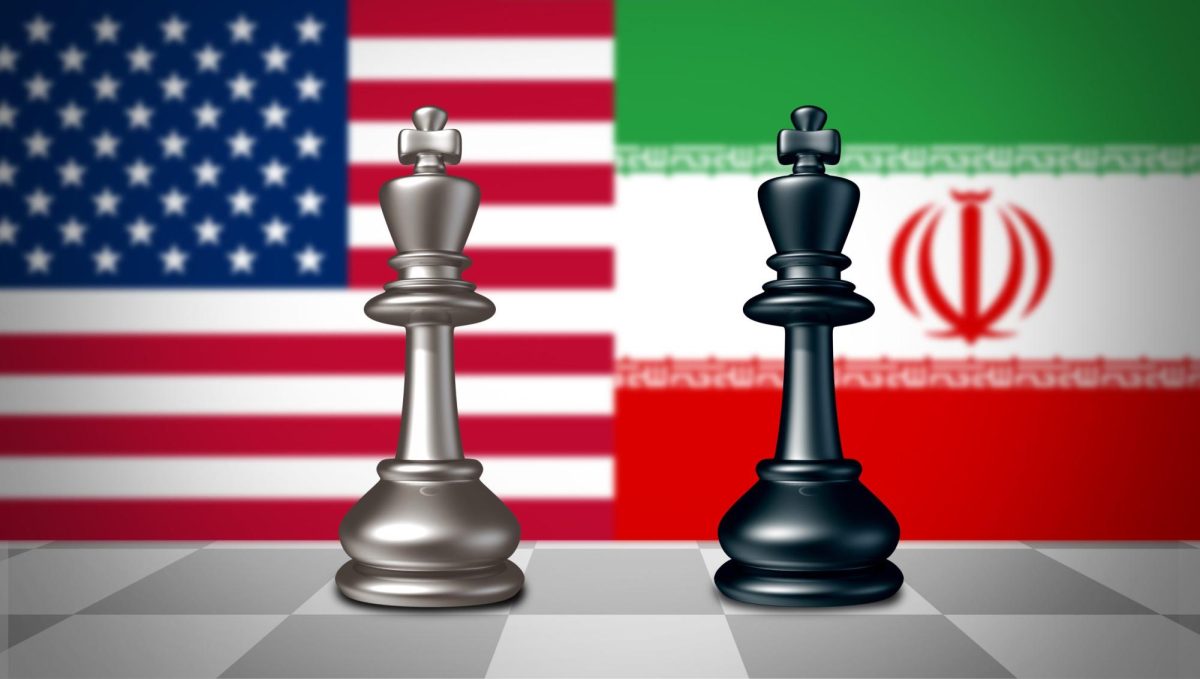
Beginning on Feb. 28, the United States of America and Israel collaborated in a series of decapitation strikes against the leadership of the Iranian government. These strikes successfully killed Iran’s supreme leader, Ali Khamenei, but failed to enact the regime change the two nations wanted.
This conflict is unlike any before. While both sides are fighting a conventional war using missiles, drones and bombs–both sides are also engaged in an incredibly complex and large-scale information war, using new war tools, such as AI-generated content. As a result, reliable information is increasingly scarce.
This brief primer is designed as a starting point for those who are unsure how the U.S. got here.
The Middle East
Due to its rich oil fields and the global world’s dependence on this fossil fuel, the Middle East is no stranger to war.
There are two notable Middle East nations involved in this conflict.
One is Israel, which presides in the West of the region and borders the Mediterranean Sea. Israel shares borders with Lebanon, Syria, Jordan, Egypt and Palestine. (Gaza and the West Bank, for clarity, are at present occupied by Israel, and have been recognized by the United Nations as a sovereign state since September 2025, known as the State of Palestine. The United States and Israel do not recognize Palestine’s sovereignty.)
The other nation is Iran, situated further to the East, and borders Iraq, Turkey, Armenia, Azerbaijan, Turkmenistan, Afghanistan and Pakistan. To its North is the Caspian Sea. To its South lies the focus of much of this conflict, the Persian Gulf, in which rests a narrow stretch of ocean, critical for global trade: the Strait of Hormuz.
Iran
Iran has a long and checkered past with the United States and Israel. Beginning in the 1950s with Iran’s democratically elected leader, Mohammed Mossadegh. Then Prime Minister of the United Kingdom, Winston Churchill saw Mossadegh as a threat to Britain and collaborated with the CIA to overthrow him.
The plan succeeded, and Mossadegh was replaced with Mohammed Reza Pahlavi, the Shah of Iran (Shah translates to king in English). His regime would remain until 1979, when he would be overthrown by the Islamic Revolution, led by Ruhollah Khomeini.
The revolution would replace Pahlavi’s monarchical government with an Islamic republic, which is essentially a religious government founded on the teachings of Shia Islam. Khomeini would go on to become the Ayatollah and Supreme Leader of Iran.
Khomeini would lead Iran in the Iran-Iraq war of the 1980s, during which the United States would initially provide aid to Saddam Hussein, then president of Iraq (The US would also illegally provide clandestine aid to Iran in the form of missiles sold to them by Colonel Oliver North in the Iran-Contra affair).
From the current government’s inception, they have essentially been at battle with the US, providing context for the current hostilities.
The Strait of Hormuz
The Strait of Hormuz, located in the Persian Gulf to the South of Iran, is a major waterway for international shipping. Through it passes 20 percent of the world’s supply of oil.
“Basically every president, starting with Jimmy Carter, up until now with what I’ll call Trump 2.0, has never looked to directly attack Iran, because of the fear that Iran would start shooting projectiles into the Strait of Hormuz… During Trump’s first term, he didn’t go there either,” said Dr. Thomas Cioppa, a professor and current chair of Brookdale’s political science department.
“The Strait of Hormuz, along with the North and South Korean border, and the area of Kashmir between Pakistan and India, has probably been the most wargamed scenario the US military has ever looked to determine,” Cioppa said.
Since the beginning of the conflict, the strait has been effectively closed by Iran, meaning no ships containing oil or any other product have passed through without Iran’s express permission, under threat of attack. This is what has led to soaring gas prices hovering in N.J. around $4.50 per gallon.
The United States of America’s Military Objectives
This history would be critical to understanding what the US’s current intentions in Iran. However, those goals have not been clear since the start of the war. Messages from the administration have been mixed.
“[The US] wants to disable Iran’s ability to project power. That means their military; that means their drones and missiles; and that means their proxies – their allies,” said Professor Chrisitan Perez, an adjunct professor of political science at Brookdale. “Can Iran project power outside of its borders? If so, how can [the US] stop that?”
President Trump and a number of his cabinet members have repeatedly asserted that some strategic goals for this campaign in Iran have been met. These statements, which on occasion have even been declarations of victory, seemingly contradict other news from the region, leading to confusion for the American people.
On April 1, a news release from the White House quoted Trump as saying, “First, we’re destroying Iran’s missile capabilities… and their capacity to produce brand new ones – pretty good ones they make. Second, we’re annihilating their navy… Third, we’re ensuring that the world’s No. 1 sponsor of terror can never obtain a nuclear weapon…And finally, we’re ensuring that the Iranian regime cannot continue to arm, fund and direct terrorist armies outside of their borders.”
Despite that statement a little more than a month ago. Cioppa said, “I genuinely don’t know what the United States is trying to accomplish… I think the idea was that… if they bombed Iran a lot that somehow the government would crumble. Or that the government would willingly and knowingly come to the negotiating table to give up its missiles. Or possibly give up its stockpile of enriched uranium.”
Israel’s Military Objectives
Israel has objectives aligned with the US regarding Iran, but also has additional goals concerning hostile neighbors in Lebanon and Palestine.
A strong US ally established in the wake of World War II, Israel suffered terroristic attacks on Oct. 7, 2023 at the hands of Hamas and other militant Palestinian groups. The country’s massive response in Gaza and throughout the region has polarized opinions both internationally and in the US.
“Israel wants the government of Iran gone. They also want Iran’s missile program destroyed. They also want to get their hands on all of [Iran’s] bomb-grade fuel. Those are the three things they want. They want the regime gone, they want the missile program gone, and they want nuclear enriched [uranium],” Cioppa said.
Israel’s prime minister, Benjamin Netanyahu, has spent a large amount of his political career advocating for intervention in Iran, arguing that the Iranians are attempting to develop nuclear weapons.
Israel has also received retaliatory strikes from Iran and has responded in kind. Israel has also launched bombing and invasion campaigns into Lebanon.
“In Lebanon [Israel] wants to eliminate Hezbollah. Hezbollah is a political party that has a lot of power in Lebanon but isn’t necessarily the governing political party,” said Perez. “Second of all, they want a buffer zone; they want to be able to control territory.”
Iran’s Military Objectives
Iran did not initiate the current combat. However, they, too, have a series of objectives they hope to accomplish.
“Iran cannot fight the United States jet for jet. They don’t have big destroyers, but what do they have? They have drones and they have the internet. So they use cheap drones and decoys to attack US military bases,” Perez said.
Seemingly, Iran’s main objective is truly survival. With the US and Israel both aiming to completely weaken or destroy Iran’s military and government, their only obvious strategic objective is ensuring that doesn’t happen. The means by which they hope to win is through the Strait of Hormuz, in a war of attrition.
“Twenty percent of the world’s oil supply goes through [the strait],” continued Perez. “[Iran] doesn’t have the ships to physically blockade it. They have the missiles and the drones to do that. They can’t threaten the United States militarily, but what they can say is, ‘we’re gonna make the global economy so bad, that it hurts the Americans’ wallets.’ And they’re hoping that it ticks off [the US’s] allies so that they turn on [the US] and pressure them to do something about it.”
One way they want to target the American economy specifically is by attacking the petrodollar. The ‘petrodollar’ describes the system by which global oil is priced and traded exclusively in USD. This gives the US a lot of bargaining and sanctioning power when it comes to oil, something they’ve spent decades attempting to uphold.
Iran, in an effort to diminish the ubiquity of the petrodollar, has begun allowing vessels through the Strait, specifically if they deal in the Chinese currency, Yuan.
“What China is looking to do is – and the Iranians were trying to facilitate this – through getting payments in Chinese currency, they’re trying to somehow shake faith in the dollar as being the principal currency by which oil is bought and sold,” Cioppa said.
“In other words they’re (the Chinese are) trying to muscle in on the action. By doing that, then the Chinese hypothetically now would be able to exert much more influence over the global oil markets,” Cioppa said.
Ceasefire
On April 8, the United States and Iran agreed to engage in peace talks, mediated by Pakistan, beginning a ceasefire between the two nations. In spite of that, Israel continued to engage Lebanon in combat.
The US and Iran, too, have engaged in a number of operations in violation of the ceasefire. The inefficiency of peace negotiations are in large part because both sides have presented unacceptable terms.
The United States wants Iran to open the Strait of Hormuz, and essentially sacrifice all of their nuclear enriched uranium. The US also wants to set up a regional system that would prevent Iran from exerting influence on the strait in the future.
Iran’s only stated objectives are the end of the conflicts in Yemen, Lebanon, Iraq and, of course, Iran. However, accepting these terms would leave the United States in an incredibly difficult position.
“This [conflict] was a gift to Iran,” said Cioppa. “Don’t get me wrong, Iran has suffered a lot of damage. There have been a lot of leadership killed. There is no question that they have lost an incredible amount of military hardware, in terms of planes, naval vessels, things like that… So why has it been a gift to the Iranians? The Iranians have done what they have always threatened to do. They, for all intents and purposes, have closed the Strait of Hormuz. They have successfully stopped boat traffic, and that has crippled the global economy.
“Everybody now is dealing with serious fallout from this war that Israel and the United States launched very quietly without consulting anybody else… the Iranians did what they always threatened they would do, and not only that, showed the world they could do it,” Cioppa said.
For the United States, at present, leaving Iran risks showing the world that a much smaller, much weaker country can effectively strike the US in economic warfare.
Where the future of this conflict lies is anyone’s guess, but for as long as it goes on, lives will continue to be needlessly lost, and the cost of gas is going to continue to climb.