











Focusing on the theme of “Democracy Takes Courage,” Brookdale held Civility Week last week from Feb. 16 to Feb. 20.
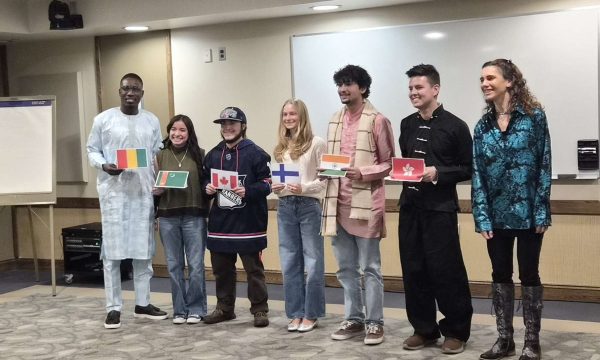
On Thursday, Feb. 19, S4GC (Students for Global Citizenship) held a student-led panel on Degrees of Democracy. S4GC adviser and English professor Kelsey C. Maki recently began teaching an Intro to Social Justice class. Six students from S4GC each represented a country of their choosing and talked about its history of democracy.
The students picked diverse countries ranging from Finland ranked in 5th for democracy to Turkmenistan ranked in 174th for democracy, as to best understand democracy we must see both sides of the extremes.
The rankings are based on the Democracy Index, an annual report published by the Economist Intelligence Unit, which measures the quality of democracy across the world using 60 indicators.
Alex Casares, a media studies major, discussed Canada, which is ranked 21st in democracy. Casaares said he chose the country because he is a hockey fan.
Mairene Cisneros, a pre-nursing and health science major, represented Turkmenistan, which ranks 174th in democracy. She said she chose to do this research to learn about her partner’s mother background.
Isabella Juska, a social science major, spoke about Finland, which ranks fifth in democracy, a country she has no personal connection to.
Yash Singh, a business administration major, represented India, ranked 151st in democracy. Singh grew up in India for the first decade of his life and wanted to use the panel to represent his country.
Tafsir Yattara, a computer science major, presented on Guinea, ranked 103rd in democracy. He is an international student and wanted to share his personal experience with democracy in his country.
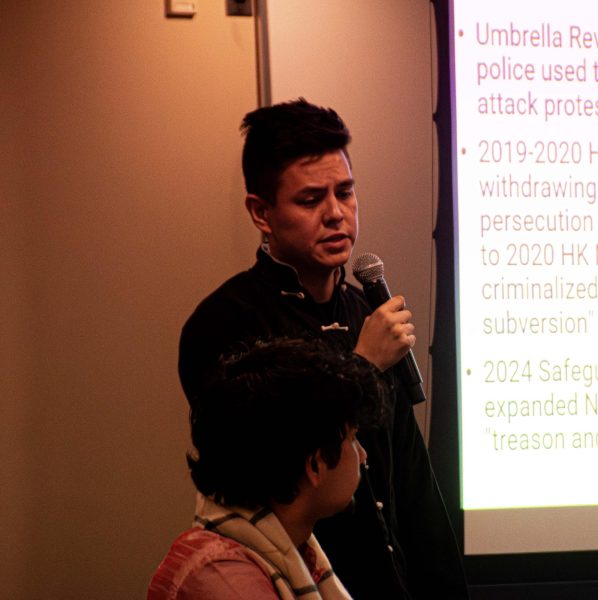 Dan Ying, a psychology major represented Hong Kong, ranked 140th in democracy. Ying said he wanted to present his father’s experience under the rule of authoritarianism.
Just as a comparison the United States is ranked 57th in democracy while ranked No. 1 is Norway and in last place is North Korea in 179th place.
Canada
In 1867 Cananda was able to self-governess after being a British colony before then, and by 1982, they were able to amend their own constitution. In 1971, Canada implemented an open immigration policy. In 1982, the Canadian Charter of Rights and Freedom were introduced, where all citizens were given fundamental rights. This is celebrated every year on April 17th. In 1933, Canada extended its voting rights to citizens with mental or intellectual disabilities.
Today, Canada has the highest level of voter participation, at over 68.7 percent for more than 30 years. Although many citizens have low trust in the current political status, they are still engaging in its government to make more changes to help the people.
Turkmenistan
In 1991, Turkmenistan gained its independence after dissolving from the Soviet Union. From 1985 to 2005, the country was under a totalitarian rule by Saparmurat Niyazov. In 2008, under the rule of Gurbanguly Berdimuhamedov, the country formed a new constitution. In 2023, Berdimuhamedov became the leader via constitutional changes.
Turkmenistan has two newspapers, but they are created by presidential decree and are under the government’s control. Turkmenistan also technically has elections, but those elections did not pass as fair when looked at by the International Standards on Democracy. Additionally, the country’s rule has been passed on through a father to son handover.
Finland
In 1809, Finland became its own governing state within the Russian Empire after separating from Sweden. In 1906, Finland created a new parliament, giving everyone the right to vote. This made Finland one of the first countries to allow women to vote and run for office. In 1917, Finland became independent after the Russian revolution. In 1919, Finland created its own constitution.
Finland has a strong democracy with free elections and protections for political rights. Citizen stay involved in voting and are able to support different pollical parties and elections can often result based on public opinion.
India
In 1947, India gained independence from the British empire led by figures such as Bhagat Singh and Sarojini Naidu. In 1950, India became a republic with a constitution establishing fundamental rights and allowing everyone to vote with no voter discrimination. From 1975 to 1977, the prime minister of India, Indira Gandhi, declared a state of emergency during which she imprisoned her political opponents and began censoring the press for her own personal gain. This became the biggest threat to India’s democracy.
India still holds massive elections and is considered a democracy. Its Supreme Court is still very active with it getting resistance from the population. This shows that the people still have a voice. Religious and political polarization has intensified as some citizens believe that the government reflects bias against majorities and anti-national interests.
Guinea
In 1956: Guinea gained its independence. Yet Guinea tends to have a repeated cycle of civilian rule to military intervention looping back to civilian rule and so forth. This is caused by weak institutions.
Currently, Guinea is once again under military intervention, and its citizens continue to have a low trust in its initiations.
Hong Kong
In 1842, British established it as colony after with the treaty of Nanking. In early 1980s, limited democratic elections were allowed. In 1991, direct election began. In 1997, Hong Kong adopted the “One Country, Two Systems” policy which made Hong Kong a part of China but governed by its own separate systems. In 2014, the “Love the Country” requirement restricted candidacy to only 2-3 candidates. This has not been popular with the people but any attempts to resist has been shut down by the government.
Hong Kong has regular protests which can often turn into the government and the police assaulting protesters with tear gas or by employing triads (a secret society involved in organized crime). The protests are not too successful and are unable to help bring about change.
After all of the panelists were done presenting, the participants were randomly separated into groups for discussion. Here are some questions that my group considered:
What are the biggest challenges to democracy around the world?
How important is a free press to democracy?
How does the United States system compare to other democracies?
Should America have the right to promote democracy to other places?
How do we preserve democracy?
Personal Account
As someone who lived in Pakistan for the first decade on my life, even if I was too young to understand it fully, I know what it’s like to live under a rule where democracy is not given and an opinion that is different from the norm is seen as heinous. Although it holds elections, a lot of Pakistan is under military influence.
Pakistan also does not have much freedom of the press and information; many websites are blocked or heavily restricted.
I remember when I was a kid and my cousin from the United Kingdom came to visit. She complained that her YouTube did not work, and she couldn’t watch her shows. At the time, I was so confused. I had never heard of the website. But when I got older and moved to the U.S., I began actually using the internet and found it fascinating for you could find almost anything online. I soon learned it is a great place to share stories, life experiences and opinions. This was not available in Pakistan.